“Should I wear Awase today?” “What if it’s too early for Hitoe…?” Changing your wardrobe for a new season can always leave you guessing.
But don’t worry! Once you know the basics, you will be able to confidently choose the perfect kimono for today’s weather.
Let’s dive into some wonderful tips that will make you want to dress up and step out in your beautiful kimono!
What’s the Difference Between Awase and Hitoe?
In short, the only difference is whether it has a lining or not. It’s that simple!
| Features | Awase (袷) | Hitoe (単衣) |
| Season to Wear | October to May | June & September |
| Tailoring | Fully lined, double-layer tailoring | Unlined, lightweight single-layer |
| Silhouette | Beautifully soft and voluminous | Light, sleek, and crisp |
| The Best Part | Your reliable go-to for chilly days! | Feels amazing with a gentle breeze passing through! |
| Why You’ll Love It | Warm, cozy, and elegantly elegant | Breathable, fresh, and looks effortlessly light! |
Quick & Easy Inspection! How to Tell Them Apart
If you’re not sure which one you’re holding, just take a peek inside the cuffs of the sleeves or the hem.
- Awase: You’ll see a white or colored fabric (the lining) attached to the inside.
- Hitoe: You’ll only see the exact same fabric as the outside.
Remember this one simple trick, and you’ll be an expert in no time!


Kimono Season: Tradition vs. Modern Reality
Here is the traditional guide. Let’s start with the basics!
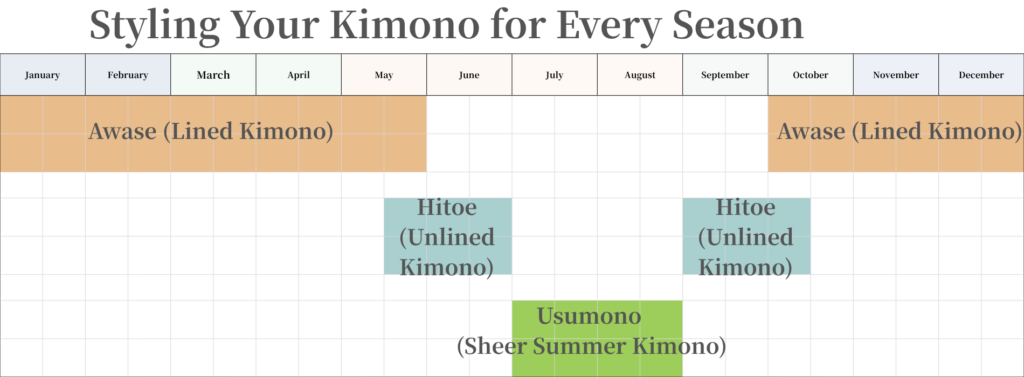
That being said, nowadays it’s not unusual to have hot, summer-like days even in May.
There’s absolutely no need to suffer through the heat just to follow the calendar!
3 Steps to Choosing Your “Kimono of the Day”
Step 1: Check the Temperature
- If the forecast predicts a high of over 25°C (77°F), go straight for Hitoe without a second thought!
- If it’s around 20°C (68°F), stay cozy in Awase. Remember, your own physical comfort is always the best rule to follow!
Step 2: Consider the Occasion
- For casual outings like lunch or shopping, feel free to switch to Hitoe the moment you start thinking, “Hmm, it’s getting a bit warm.” * For formal events, simply choose materials that match the elegance and dress code of the occasion.
Step 3: Play with Seasonal Accessories
- If you’re wearing Hitoe in May, pair it with refreshing, spring-colored sashes (obi) and accessories. Starting by switching just the kimono itself to Hitoe—while keeping the accessories spring-like—is the easiest and most stylish way to transition! It is perfectly fine to keep using your regular spring collar (haneri) and sash scarf (obiage).
Styling Your Hitoe Kimono for Every Occasion
It would be such a waste to think, “The Hitoe season is too short to bother with!” Because it has no lining, Hitoe is incredibly lightweight and creates a stunningly sleek, beautiful silhouette. That’s the real magic of Hitoe!
Let’s look at the three most popular types of Hitoe kimono, along with the perfect occasions and styling tips for each.
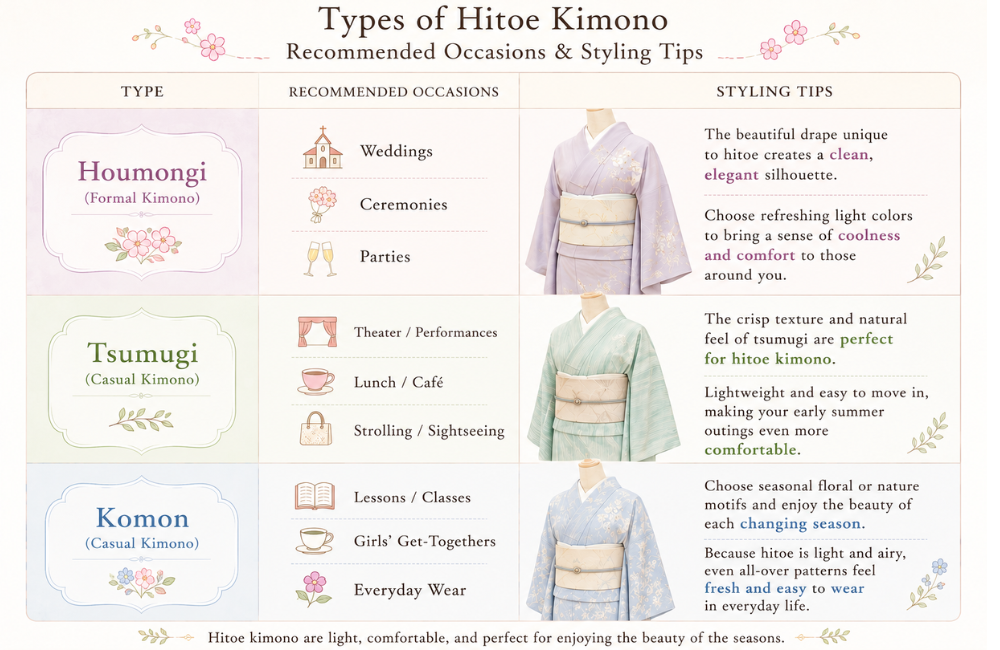

An elegant, beautifully refreshing Hitoe Homongi featuring soft, pastel floral patterns that catch everyone’s eye.

A wonderfully light Hitoe Tsumugi outfit, beautifully featuring charming and gentle floral patterns.

A beautiful, refreshing light blue Hitoe Komon that captures the perfect, breezy vibe of early summer
Conclusion: Rules Are Here to Guide You, Not to Bound You!
- How to Tell: Just peek inside the cuffs and the hem to check if there is a lining.
- When to Wear: Traditionally June and September—but in the modern world, be flexible and dress for the daily temperature!
- Pro-Tip: You don’t have to change everything to summer style all at once. Start simple by switching just the kimono to Hitoe first!
Remember, rules are not here to restrict you; they are your guide to looking and feeling even more beautiful.
Once you know the difference, there is nothing to worry about! For your next outing, why not choose the perfect piece for the weather and experience the amazing comfort of a gentle breeze passing through?
The moment you take that first step, your kimono life will become so much lighter, freer, and full of joy!
I once attended a wedding in late May wearing a Hitoe Homongi (an unlined, semi-formal kimono). The weather forecast predicted a very warm day, so I took a chance and chose Hitoe—and it was the best decision! I stayed cool, could move around easily, and felt perfectly comfortable all day long.
In fact, people even came up to me to say, “Your kimono looks absolutely lovely!” Dressing for the actual temperature not only keeps you comfortable but also gives you a wonderfully fresh and radiant look that delights everyone around you.