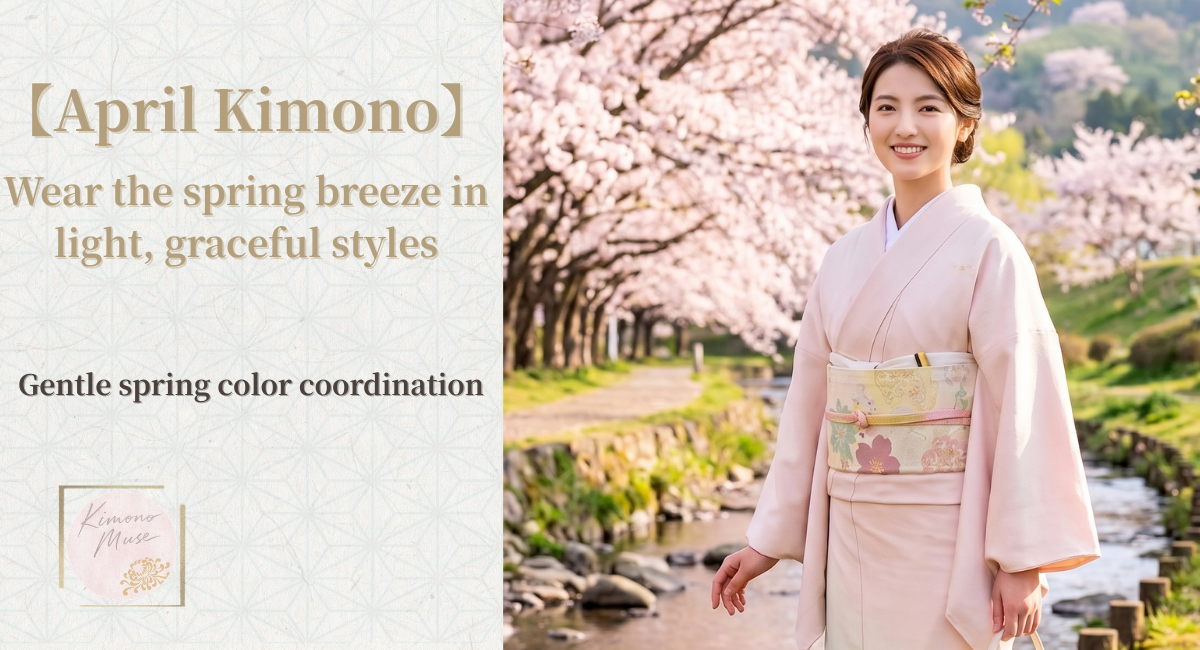
Bright spring sunshine, the arrival of cherry blossoms, and a heart full of excitement — April is finally here.
This is peak spring season, and likely the time of year when you’ll have the most opportunities to wear kimono: hanami (cherry blossom viewing), entrance ceremonies, or gatherings to celebrate new beginnings.
But when you sit down to plan your outfit, questions like these might come up:
“The cherry blossoms have already fallen — what patterns should I choose now?” “On days when it suddenly gets warm, won’t a lined kimono be too hot?”
Sound familiar? These are very common questions for this time of year.
The key to April kimono dressing is to move one step beyond March’s “clarity,” and instead focus on “color harmony” — letting your outfit resonate with the world blooming around you.
In this article, we’ll share tips for creating coordinates that truly shine in spring light, along with some clever tricks for staying comfortable.
The Keyword for April Kimono: “Color Harmony”

While March was about shedding winter’s heaviness, April is all about “color harmony.”
As flowers burst into bloom and fresh green leaves emerge, try gradually shifting your kimono colors and patterns toward ones that feel full of life and energy — just like nature itself.
Being mindful of a color palette that doesn’t just look light, but actually blends with the scenery around you, will make every outing feel like a truly special occasion.
April Colors: Enjoying the Gradual Shift as a Gradient
One of the great joys of kimono is being able to express the changing of seasons through color.
In April, the colors that suit you actually shift between early and late in the month — almost like turning the pages of a calendar.
Going along with that change is the first step to becoming truly skilled at kimono dressing.
✿Early April: Cherry Blossom & Petal Shades — Warm Tones to Savor the Last of Spring

A soft, delicate pink — the classic cherry blossom color

A pale pink with just a touch of red warmth

A vibrant, lively spring pink

A gentle, creamy off-white

A refined, dusty rose with a subtle muted quality

A soft, dreamy light purple with a hint of wisteria


✿Late April: Young Leaf & Fresh Green Shades — Cool Tones That Feel Like a Fresh Spring Breeze

A fresh, vibrant yellow-green like new seedlings

A soft, gentle young-leaf green

A pale, transparent green with an airy quality

A cool, blue-tinted pale green — like fine celadon porcelain

An elegant, soft purple

A delicate, light wisteria purple


April Patterns: There Are “Chic Rules” to Pattern Selection
Kimono pattern selection follows a time-honored tradition of “reading the seasons.”
Here are the recommended motifs for April:
| Pattern | Seasonal Feel | Meaning / Atmosphere | Easy-to-Match Colors |
|---|---|---|---|
 Sakura Sakura | Late March – Early April | A symbol of spring with celebratory elegance for new beginnings and prosperity | Cherry Blossom Pink, Ash Pink |
 Canola Blossoms Canola Blossoms | Late March – Early April | Bright hope with a cheerful and approachable charm | Cream Yellow, Fresh Green |
 Willow Willow | Late March – Mid-April | Strong vitality with graceful movement in the wind | Willow Green, Pale Green |
 Spring Haze Spring Haze | Throughout April | A peaceful spring landscape with an elegant and dreamy atmosphere | Pale Wisteria, Cream Yellow |
 Butterfly Butterfly | Throughout April | Healthy growth with a light and delicate feeling | Pink Carnation, Cherry Blossom Pink |
 Shell Matching Shell Matching | Early – Mid-April | A symbol of marital harmony and classical court elegance | Soft Plum Pink, Pale Wisteria |
 Wisteria Wisteria | Mid – Late April | Noble beauty with graceful hanging blossoms | Pale Wisteria, Pale Green |
 Swallow Swallow | Mid – Late April | A sign of happiness with a stylish sense of movement | Pale Green, Pale Wisteria |
 Fresh Leaves Fresh Leaves | Late April – Throughout May | Fresh vitality and a clean, refreshing impression | Young Green, Willow Green |
 Peony Peony | Late April – Early May | “The King of Flowers,” symbolizing beauty and prosperity | Pink Carnation, Soft Plum Pink |
 Azalea Azalea | Late April – Early May | Familiar spring brilliance that colors the streets | Pink Carnation, Young Green |
 Flowing Water Flowing Water | From Late April | Clear flowing water that brings an early summer freshness | Pale Wisteria, Pale Green |
How to Balance Lightness and Comfort as Temperatures Rise
You may have come across the term “awase (袷)” kimono and wondered what it means.
Awase simply refers to a lined kimono — one with an inner lining sewn in — worn from around October through May. It’s the most common type of kimono for spring and autumn.
However, by late April, temperatures can easily climb above 20°C (68°F). So how do you stay comfortable?
The answer is: you don’t need to change the kimono itself. A few small, clever adjustments to what you can’t see from the outside make all the difference.
✿Switch Your Nagajuban to a Summer Style — Get Ahead of the Season

The nagajuban (長襦袢) is the under-kimono worn beneath your main kimono — think of it like a slip or lining garment. Keep your awase kimono as-is, but swap the nagajuban for one made from linen or polyester summer fabric. This one hidden change dramatically lowers how warm you feel.
💡 Beginner’s Note: The nagajuban is invisible when you’re wearing your kimono, but it’s the layer closest to your skin — so the fabric matters a lot for comfort. Switching to a breathable summer fabric here is one of the smartest moves you can make in late spring.
✿Use Breathable Materials Around the Obi

The obiita (帯板) is a flat board slipped inside the obi (the wide sash) to keep it smooth and structured — and it turns out this is the area where heat builds up most. Switching to an obiita made from loofah (hechima) material allows excellent airflow and significantly reduces back sweatiness.
💡 Beginner’s Note: Loofah (hechima — ヘチマ) isn’t just a bath product! In kimono dressing, hechima-based accessories like the obiita and obi makura (the pad that shapes the back of the obi) are beloved for their breathability. They’re a summer kimono essential in Japan.
✿Cool From the Inside: A Breathable Inner Coordinate

Two more items worth knowing about:
Tube-sleeve han-juban (筒袖の半襦袢) A simplified under-kimono with straight, tube-shaped sleeves. Because the sleeves don’t taper, air circulates much more freely around your arms. Best suited for casual occasions.
Wavy-texture kimono leggings (和装楊柳ステテコ) Yōryū (楊柳) refers to a crepe-like fabric with a fine, textured surface. Worn beneath the kimono like shorts or leggings, they prevent the fabric from clinging to your legs as you walk — a game-changer for comfort.
💡 Beginner’s Note: These inner layers are completely hidden under your kimono, but they make a huge difference in how comfortable you feel. Think of them like moisture-wicking base layers under regular clothes — invisible, but essential!
Summary
The key to enjoying April kimono is really just three things:
1. Colors: Think “Harmony” Follow nature’s lead — shift from cherry blossom pinks in early April to fresh greens by late April. Let your palette change with the scenery around you.
2. Patterns: Embrace the “Flow of Time” Wear petals as they fall, then welcome wisteria and butterflies as they take the stage. Dressing in step with the season’s natural progression is the true art of kimono.
3. Comfort: Work from the Inside Out Swap your nagajuban and obiita for summer-friendly versions. These hidden changes keep you cool without changing a single thing about your outward look.
“I wonder what color would look beautiful against today’s sky?”
Just imagining that is enough to make your spring a little more radiant.
Why not welcome the new season in your very best kimono?